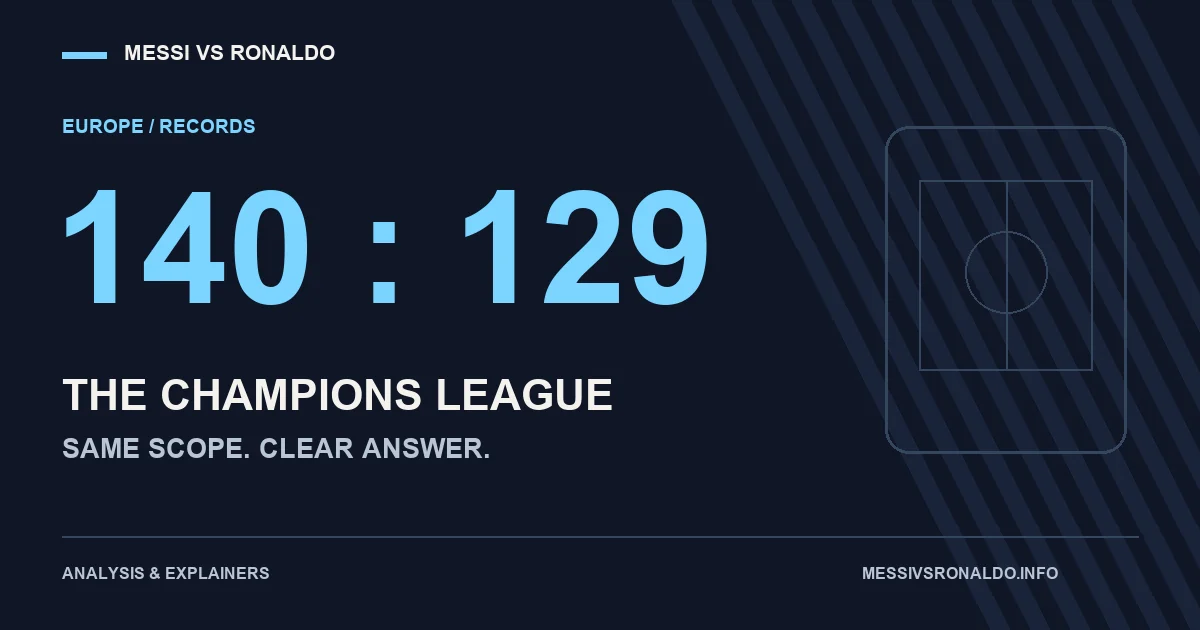
Cristiano Ronaldo leads Lionel Messi 140–129 in Champions League goals excluding qualifying. Include qualifying rounds and Ronaldo’s total becomes 141; Messi’s stays 129. UEFA publishes both scopes. The apparent contradiction comes from comparing tables with different boundaries.
Checked on 28 October 2026, this guide explains the goal figures used on our Champions League comparison page. It is a goals comparison, rather than a claim to settle every part of their European careers.
Who scored more Champions League goals?
UEFA’s all-time scoring guide, dated 21 October, explicitly separates the competition proper from qualifying. In the former, Ronaldo leads by 11 goals. When qualifying is included, the difference becomes 12.
| Goal scope | Messi | Ronaldo |
|---|---|---|
| Champions League proper | 129 | 140 |
| Qualifying contribution | 0 | 1 |
| Combined | 129 | 141 |
Where does Ronaldo’s extra goal come from?
UEFA’s Ronaldo career guide identifies a qualifying goal against Debrecen in 2005. It belongs in a qualifying-inclusive table. It should not be added to a 140-goal competition-proper figure and then described as though the scope had stayed the same.
For a career total across all competitions, that qualifying goal is counted once. Moving between a combined table and a competition breakdown should reorganise the same record, rather than create another goal.
How do their goals break down by club?
Our shared competition ledger gives the following split; Ronaldo’s three-club figures also match UEFA’s player guide:
| Player | Club | Goals |
|---|---|---|
| Messi | Barcelona | 120 |
| Messi | Paris Saint-Germain | 9 |
| Ronaldo | Manchester United | 21 |
| Ronaldo | Real Madrid | 105 |
| Ronaldo | Juventus | 14 |
What does the comparison tell us?
Ronaldo has the larger total across the competition proper. Messi has the larger contribution for a single club in this two-player comparison: 120 for Barcelona against Ronaldo’s 105 for Real Madrid. The answer changes because the question changes from a career total to a club-specific total.
That is a useful way to approach the broader debate. Decide whether you want total scoring, a particular club era or a narrower set of matches, then apply that boundary to both players. A headline number is easier to assess when its definition is visible.
Can this table tell us who had the better scoring rate?
Goals alone cannot establish a per-match or per-90-minute rate. You need appearances or minutes covering exactly the same set of games. Mixing a qualifying-inclusive appearance count with a competition-proper goal count would introduce another mismatch.
Explore the Messi goal explorer and Ronaldo goal explorer for the underlying scoring record. Our methodology explains why unsupported rate metrics remain unavailable in the shared goal-only dataset.