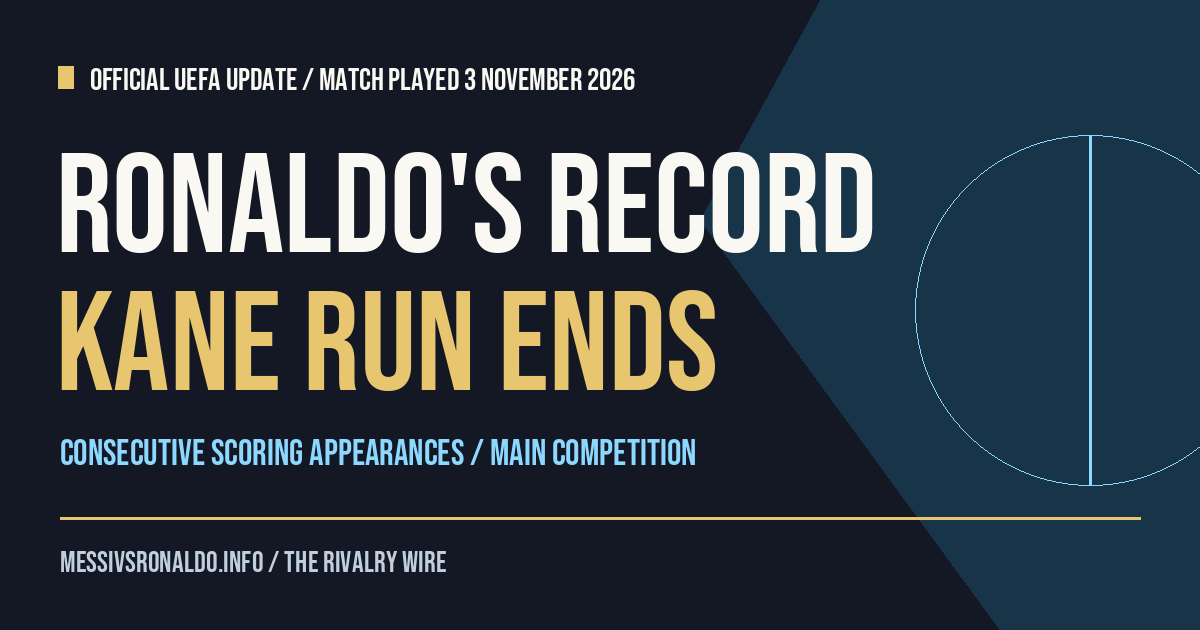
UEFA confirms Kane did not score in Bayern’s win at Atlético, ending his run short of Ronaldo’s record.
Our take: Counting appearances in our archive, Ronaldo’s longest Champions League scoring run is 11 matches, compared with Messi’s 5. This counts successive appearances, so it should not be confused with goals in successive team fixtures or a single-season scoring record. Compare Champions League goals →Inspect Messi’s 2016 Champions League appearances →Analysis uses records reviewed .
Official UEFA update · completed match and own archive calculation reviewed
Editorial illustration · messivsronaldo.info
Harry Kane’s Champions League scoring streak is over after he failed to score in Bayern Munich’s 2–0 win at Atlético Madrid on 3 November. UEFA’s updated official record page confirms the outcome.
That leaves Cristiano Ronaldo’s sequence of scoring in 11 successive appearances as the competition benchmark, with Kane’s run ending at 10. This is a scoring-streak record, rather than a comparison of their overall career goal totals.
Ronaldo’s run spans the 2017 final and the following campaign. UEFA’s list covers the main competition from the group or league phase through the final, so qualifying is outside this particular record.
Our comparison uses the site’s dated appearance archive, including games in which Messi or Ronaldo did not score. It describes consecutive player appearances: a match a player misses is not silently treated as a zero-goal appearance.
Sources & checks
UEFA · consecutive Champions League scoring games, 3 November 2026 ↗ Full official page fetched after the match says Bayern won 2–0, Kane did not score and his run ended. The page is dated 3 November; its embedded morning timestamp does not establish when the post-match wording was added, so no precise update time is asserted. · Checked 3 Nov 2026, 23:58 GMT
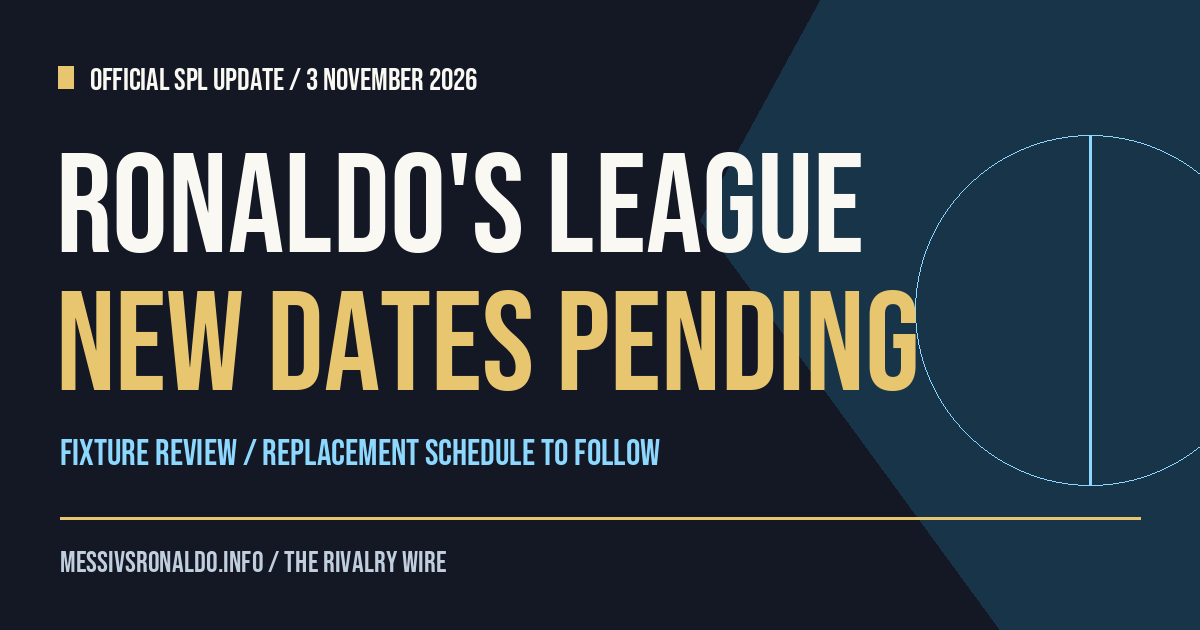
Saudi Pro League says Matchweek 13 will be rescheduled, with replacement dates to follow after a club review.
Our take: Ronaldo needs 15 more goals in our ledger, compared with 63 for Messi. With the league calendar being revised, the Race to 1,000 simulator’s constant scoring pace should be read as a scenario rather than a fixture-based finish date. Race to 1,000: test a scoring scenario →How eligible goals are counted →Analysis uses records reviewed .
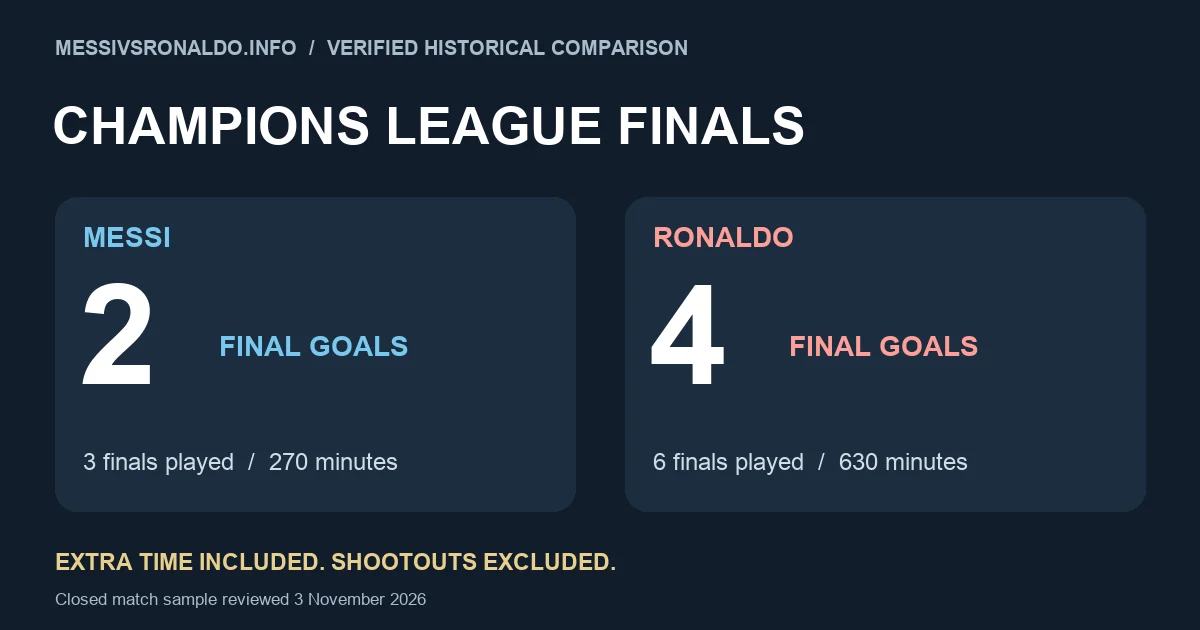
Ronaldo has four Champions League final goals and Messi two. Compare verified appearances, minutes and rates, with shootouts and team titles kept separate.
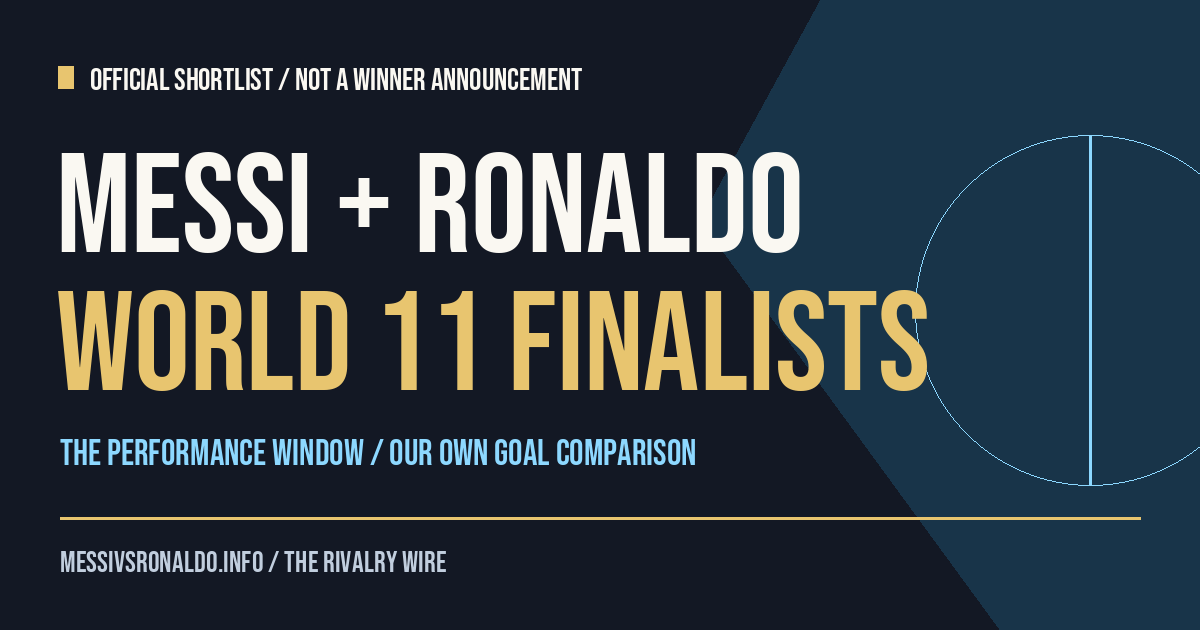
FIFPRO lists both forwards among its finalists; the men’s team will be revealed on 9 November.
Our take: Across FIFPRO’s stated performance window, our senior-goal ledger records 45 for Messi and 38 for Ronaldo. That dated comparison is more relevant here than today’s career totals, although goals alone do not decide a player-voted team. Compare the stated performance window →Goal scope and sources →Analysis uses records reviewed .
AFA’s official squad omits Messi after his international farewell; Argentina prepare for November friendlies.
Our take: Our ledger has Messi on 126 Argentina goals and Ronaldo on 146 for Portugal: a gap of 20, compared with 48 across their whole careers. Club goals can move the Race to 1,000, but they do not alter the international comparison. Messi’s Argentina goals →Ronaldo’s Portugal goals →Analysis uses records reviewed .
Official AFA squad graphic inspected · country and career goal scopes reviewed
UEFA confirms Kane did not score in Bayern’s win at Atlético, ending his run short of Ronaldo’s record.
Our take: Counting appearances in our archive, Ronaldo’s longest Champions League scoring run is 11 matches, compared with Messi’s 5. This counts successive appearances, so it should not be confused with goals in successive team fixtures or a single-season scoring record. Compare Champions League goals →Inspect Messi’s 2016 Champions League appearances →Analysis uses records reviewed .
Official UEFA update · completed match and own archive calculation reviewed